Migrating to Shopify from BigCommerce
Move from BigCommerce to Shopify with a migration built to protect SEO, clean up operations, and improve storefront performance.

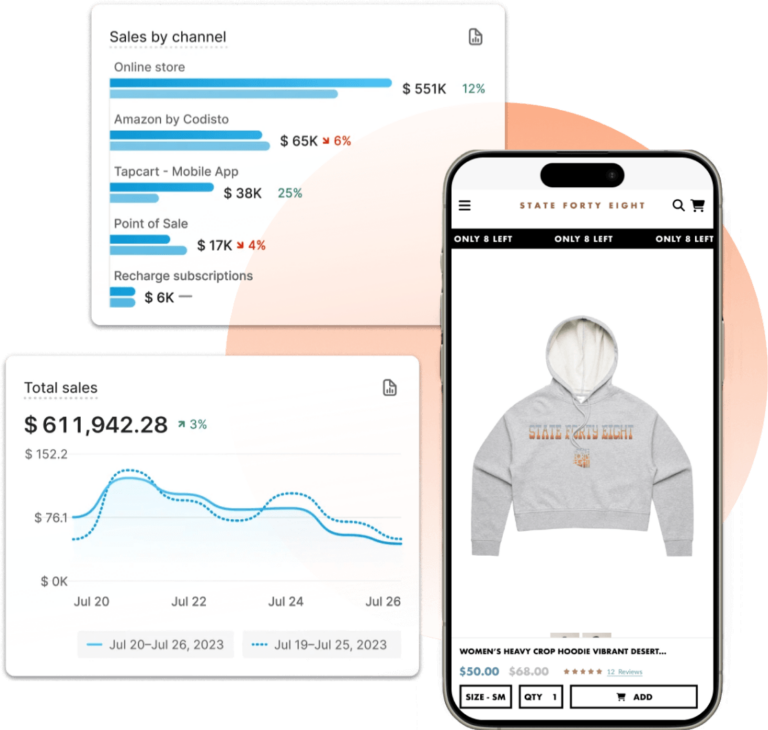
Unleash speed, adaptability, and reliability with Shopify’s unified commerce platform.
BigCommerce can work well, until you hit limits around customization, workflow complexity, app and integration sprawl, or the need for faster iteration across storefront and operations. Fyresite migrates BigCommerce stores to Shopify with a structured plan that prioritizes data integrity, conversion, and scalability.
Common Struggles from BigCommerce Users
- Platform constraints and slow iteration
- Complex catalogs and variant logic
- App sprawl and messy integrations
- Performance and UX conversion issues
- SEO risk during replatforming



Expert Support Every Step of the Way
Scale your complex product catalogs by migrating from BigCommerce to Shopify Plus.
If your store needs more flexibility, stronger platform operations, or a faster path to optimization, Shopify Plus can simplify your stack and improve speed to market. We migrate your storefront with clean data, dependable integrations, and an experience designed to convert and scale.
Frequently Asked Questions
All of Your BigCommerce to Shopify Migration Questions Answered
What do you migrate from BigCommerce to Shopify Plus?
Our baseline migration includes products and variants (titles, descriptions, images, SKUs), categories and collections, product options and option sets, customer records, selected historical orders, site pages and content, navigation, and available SEO metadata. We also migrate prioritized blog content and any available social image metadata. Exact fields and volumes are confirmed during Discovery and documented in the SOW.
How long does a BigCommerce to Shopify Plus migration take?
Time depends on catalog size, number of integrations, required custom features, and whether multiple storefronts are involved. Typical engagements for standard storefronts run several months. More complex migrations that include bespoke apps, heavy integrations or multiple storefronts may require additional time.
What will the migration cost?
Costs vary with scope, integrations and design requirements. Project pricing ranges from mid-five figures for straightforward replatforms to larger budgets for enterprise programs that require custom apps, complex integrations or multi-store efforts. Discovery produces a firm scope and commercial proposal.
How do you handle BigCommerce product options, modifiers and complex SKUs?
BigCommerce supports product options, option sets and modifier logic that often differs from Shopify variants. We model complex product types using Shopify variants, metafields/metaobjects and theme logic or, where necessary, lightweight custom apps so that option selection, inventory handling and cart representation match the business rules accepted by backend systems.
How do you preserve SEO and existing BigCommerce URLs?
We create a URL mapping plan and implement 301 redirects for high-value product, category and content URLs. We migrate available SEO metadata and run pre-launch and post-launch crawls to remediate 404s. The Discovery phase determines the canonical structures to preserve organic visibility.
Can you migrate customer accounts and passwords?
Customer records are migrated. Password hashes are typically non-portable between BigCommerce and Shopify. Standard practice is to migrate customer accounts without passwords and trigger a secure password reset or login invitation flow so customers can set new credentials. We document the customer experience and communicate timing to the client.
Will you migrate orders and order history?
We migrate customer and order data according to the window agreed during Discovery. Clients commonly choose a rolling window such as the last 12–24 months, but other ranges are available. Order numbers can be preserved in many scenarios, but logistics and accounting reconciliation are planned in Discovery to avoid downstream issues.
What happens with BigCommerce apps and customizations?
Apps and server-side customizations on BigCommerce are not directly portable. We evaluate each capability and follow a native-first approach: use Shopify native features or vetted Plus apps when possible, and build custom apps when required to match business logic. Any major third-party or bespoke system that cannot be replaced is integrated via middleware or a custom connector.
Are payment methods and tokenized payment data migrated?
Tokenized payment data and vaults rarely transfer between payment providers. Payment methods need to be reconfigured on Shopify. Customer payment tokens are generally not migratable and customers will need to re-enter or re-tokenize payment details when they next checkout or via secure re-tokenization flows.
How do you handle subscriptions and recurring billing?
Subscription platforms are vendor-specific. Subscription records, tokens and billing schedules require a provider-specific approach. We assess feasibility during Discovery and coordinate migrations with the subscription vendor or propose migration to a supported subscription platform on Shopify Plus.
How do BigCommerce B2B features map to Shopify Plus?
BigCommerce Price Lists, Customer Groups and custom pricing patterns are mapped to Shopify Plus B2B primitives, Apps or custom app logic. We document required wholesale behavior in Discovery and implement mapped solutions that support catalog segmentation, net terms, approval workflows and contract pricing.
What about multi-store or multi-site BigCommerce setups?
Enterprise multi-storefront patterns are evaluated in Discovery. Shopify Plus supports multi-market and multi-store strategies. Depending on the requirement, we may recommend a single Plus instance with Markets and localization, a headless approach, or multiple Shopify stores. We document tradeoffs for content duplication, global inventory and shared integrations.
How are integrations handled (ERP, PIM, logistics, marketplaces)?
Integrations are planned and scoped during Discovery. We commonly use middleware, ETL tools or custom connectors to synchronize inventory, pricing and orders with ERPs and PIMs, and to manage channel reconciliation for marketplaces. Responsibilities for reconciliation, error handling and rate limiting are defined in the SOW.
Can we replicate BigCommerce checkout customizations and scripts?
Shopify checkout is a SaaS-managed environment with platform constraints. Theme-level styling and supported checkout settings are included. Deep, server-side checkout customizations require separate scoping and may be addressed with Shopify Plus checkout extensibility, checkout apps or alternate UX patterns. Third-party checkout scripts that run in the storefront are evaluated for migration or replacement.
What is the launch process and post-launch support?
We deliver in phases: Discovery, Design and Development, QA and UAT, Launch, and hypercare. Hypercare and handoff training are part of the standard approach so operational teams can manage the storefront. We define launch readiness criteria, cutover plans and rollback contingencies in the SOW.
What is typically out of scope?
Typical exclusions include provider-specific BigCommerce server code, unsupported checkout engine modifications, fully custom theme builds without separate agreement, and large-scale BI or data warehousing replacements unless explicitly scoped. Any out-of-scope items are recorded in the SOW and handled via Change Order if requested later.
Stop fighting your platform.
When your team is spending too much time working around platform limitations instead of improving merchandising and customer experience, it’s time to migrate with a plan. Fyresite moves BigCommerce stores to Shopify with careful data mapping, SEO protection, and a launch process built to reduce risk so you can iterate faster post launch.
Get a quote from our ecommerce experts
LET’S SCALE YOUR STORE