 Taylor Simmons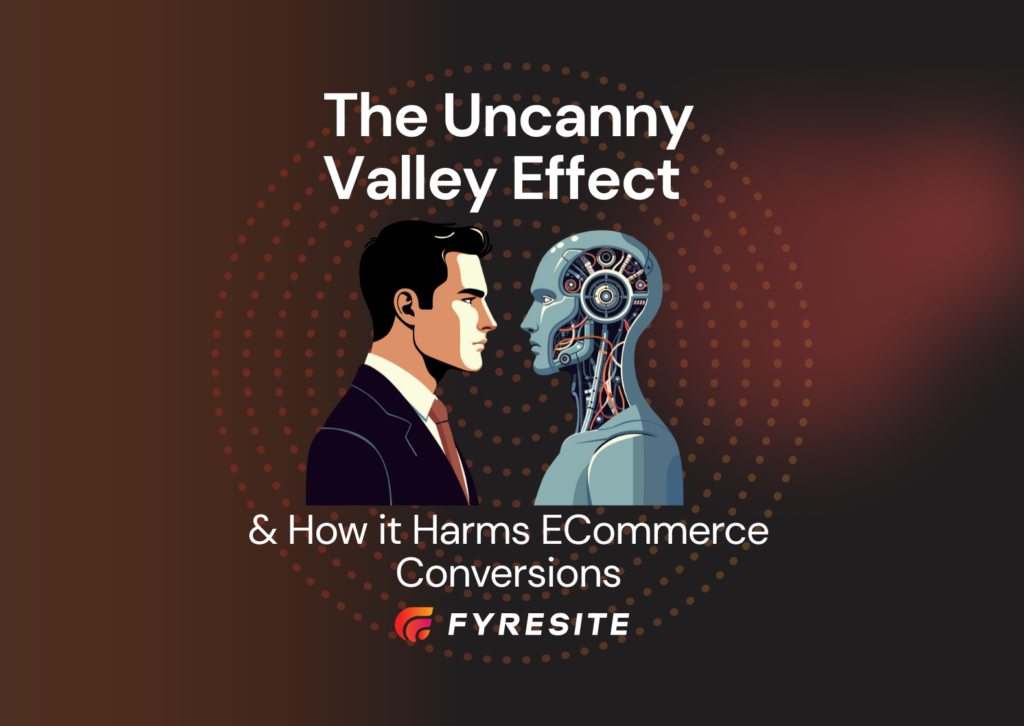
The AI boom has hit every bit of the online experience, including eCommerce. Whether merchants choose to use AI generated images for product images, social posts, or store design, careful use is important. And it’s not just because some customers may dislike AI.
If you’re using AI images without care, you may be making your customers victims of the Uncanny Valley Effect.
What is the Uncanny Valley Effect?
Coined by robotics professor Masahiro Mori in 1970, the Uncanny Valley Effect (sometimes called the uncanny valley phenomenon) refers to the feelings a robot causes in a human.
As a robot becomes more human-looking, responses become more empathetic, until the robot looks almost human, which causes feelings of revulsion.
Scientific studies have shown that brain activity suggests humans feel uncomfortable with the disconnect between how a robot looks (human) and how it acts (robotic). There’s many theories as to why this happens, ranging from the instinct to avoid disease, the instinctual fear of death, and even the need to find an ideal mate.
How does the Uncanny Valley Effect Relate to AI Images?
A study conducted by the Massachusetts Institute of Technology has shown that the Uncanny Valley Effect is “not confined to physical robots but persist in text-based dialogue and AI-synthesized images.”
AI learns from information it gets from humans, but the machine can’t perfectly replicate what a human can do. This causes the feeling of dread associated with the Uncanny Valley Effect due to the “almost human, but not quite” products made.
Examples of the Uncanny Valley Effect
One of the most famous examples of the Uncanny Valley Effect comes from the 2004 film The Polar Express. Early CGI led to clunky movements instead of the fluid movements of a human, and the eyes of the characters were often dull, unmoving, and unblinking.

Another famous example of the Uncanny Valley Effect? The viral Will Smith Eating Spaghetti video. Made as a way to show the limitations of AI video generation in 2022, the almost Will Smith caused great discomfort.
Common Causes of the Uncanny Valley Effect & How to Avoid Them
We know that AI images can trigger Uncanny Valley responses, but why? What exactly is it in these images that give customers a sense of dread?
It’s because our brain can see the small things that we aren’t processing.
AI Images with People
In AI images with people, there’s a few key things to avoid in order to prevent triggering the Uncanny Valley response.
- Perfection is not perfect
- You might be tempted to make the people in your images look perfect. Don’t.
- A lack of pores, scars, marks, or texture on skin instantly signals that the person in the image isn’t real
- Perfect symmetry is unrealistic and a quick way to turn customers off
- You might be tempted to make the people in your images look perfect. Don’t.
- The eyes have it
- They say the eyes are the window to the soul. Whether or not that’s true, the eyes are a key aspect of preventing the Uncanny Valley Effect
- Like in The Polar Express, eyes that are dull, unfocused, or have a ‘dead’ stare will make your customers uncomfortable
- They say the eyes are the window to the soul. Whether or not that’s true, the eyes are a key aspect of preventing the Uncanny Valley Effect
- Watch the hands
- A complaint noted since the explosion of AI image generators, hands are important to get right
- Lack of texture, joints, or proper shape make customers uncomfortable, as do hands in wrong places, the wrong number of fingers, and inaccurate hand positioning
- A complaint noted since the explosion of AI image generators, hands are important to get right
AI Images with Products
In general, we don’t recommend that you use AI for your product image. It’s better to photograph your actual product, so customers know exactly what they’re getting. However, it’s very common to use AI to generate backgrounds and to enhance your product image.
Since you’re mixing a human element (product image) with an AI element (background/enhancements), it’s important to avoid certain pitfalls.
- Check the light
- One of the most common issues when a real image is placed on an AI background is mismatched light sources
- When generating the background, make sure the light in the background comes from the same area the light in the photo comes from.
- This is especially important when the background uses outside imagery and has the sun or moon in the background
- When generating the background, make sure the light in the background comes from the same area the light in the photo comes from.
- One of the most common issues when a real image is placed on an AI background is mismatched light sources
- Obey the laws of science
- AI doesn’t always remember to obey the laws of physics
- Make sure products aren’t floating or passing through items in the background
- Make sure that your product is proportional to the other items in the image
- AI doesn’t always remember to obey the laws of physics
- Verify materials behave realistically
- Certain materials are expected to look a certain way. If objects in an AI generated image don’t match the real-life objects they’re supposed to, it’ll make customers uncomfortable
- If your background is a beach cabana, the fabric of the cabana should be light and airy, allowing sunshine through. If the fabric is heavy and opaque, it breaks the illusion
- Certain materials are expected to look a certain way. If objects in an AI generated image don’t match the real-life objects they’re supposed to, it’ll make customers uncomfortable
Will AI Images Cross the Uncanny Valley?
While this is a great question, there’s no easy answer.
First, there’s no one proven reason that humans feel the Uncanny Valley Effect. Without knowing exactly why the almost-human element of AI images causes this sense of dread, we can’t say with certainty whether or not it can be overcome.
Also, social and cultural upbringings also play a role in the effect that we don’t completely understand. The way that a certain society and/or culture views technology and the amount of exposure they have to it may change their willingness to accept AI-generated images. Age and technical literacy also plays a role.
For example, children who grow up watching movies like The Polar Express might find the dissonance between humans and human-like animation less distressing than someone who grew up without any CGI or AI movies.
Some people believe that newer AI models (like Midjourney and Nano Banana) have already bridged the gap, while others believe that there will always be something not-quite-human enough about AI generated content.
Fyresite Can Help
Are you worried that your eCommerce website design will turn potential customers off due to the Uncanny Valley Effect? Our award-winning team, including top graphic designers, can help. Schedule your consultation now to learn how we can help optimize every aspect of your online store.