Migrating to Shopify from SAP Commerce Cloud
Move off six-figure licensing and a Java release cycle onto a platform your merchandising team can run without a development ticket.

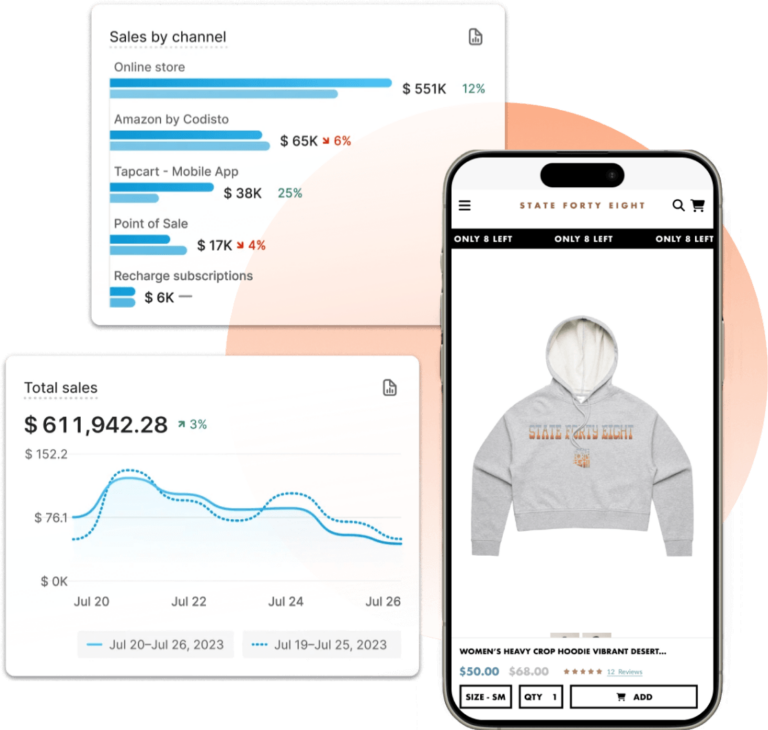
Unleash speed, adaptability, and reliability with Shopify’s unified commerce platform.
Ditch the SAP Commerce Cloud release cycle. We migrate your catalog, customer hierarchies, and order history into a single high-performance Shopify Plus storefront, and keep the ERP and tax integrations your operation already depends on. No accelerator templates, no cartridge sprawl, no waiting on a Java sprint to change a price.
Common Struggles from SAP Commerce Cloud
- Six-figure licensing before your first sale
- Every storefront change needs a Java developer
- Composable Storefront migrations with no end
- Release cycles measured in months, not days
- Infrastructure and DevOps you must staff for
Expert Support Every Step of the Way
We ensure your transition is zero-downtime and zero-stress.
Frequently Asked Questions
All of Your SAP Commerce Cloud to Shopify Migration Questions Answered
What does a SAP Commerce Cloud to Shopify Plus migration include?
Baseline scope covers the product catalog and variants, classification attributes, categories mapped to collections, media, price rows, customer records, a prioritized window of order history, CMS content, navigation and available SEO metadata. Exact item types, field mappings and record counts are confirmed during Discovery and documented in the SOW.
How do you get data out of SAP Commerce Cloud?
We export through ImpEx, Backoffice exports and the Commerce Cloud APIs, working against the online catalog version rather than staged so the dataset matches what customers actually see. Where hotfolders or Data Hub feed the platform from an upstream system, we usually source directly from that system instead, since it produces cleaner data than re-exporting from Commerce.
How do SAP Commerce classification attributes and variant types map to Shopify?
Classification classes and classification attributes become Shopify metafields and metaobjects with defined types, so faceted filtering and spec tables survive. Variant product types map to Shopify variants where the axis count allows; beyond Shopify’s variant ceiling we model the family as a metaobject-driven product group so selection and inventory still behave correctly.
What happens to price rows, price rules and the promotion engine?
Base price rows migrate as Shopify prices with customer-specific pricing moved into Shopify Plus B2B catalogs and price lists. SAP’s rule-based promotion engine has no one-to-one equivalent, so we inventory active rules in Discovery and rebuild them with Shopify Functions, native discounts or Scripts, and flag any rule that can’t be reproduced before you commit to scope.
How is WCMS content and SmartEdit handled?
Content catalogs, content slots and CMS components are mapped to Shopify pages, sections and metaobjects so marketing keeps modular, editable layouts. Editors move from SmartEdit to the Shopify theme editor, which is a meaningful simplification. Most teams stop needing a developer for routine content changes.
We're on the Composable Storefront (Spartacus). Does that change the migration?
It changes the front end more than the data. A Spartacus storefront can be replaced with a Shopify Online Store 2.0 theme, or you can stay headless on Hydrogen and the Storefront API if you have a real reason to. We document the tradeoffs on performance, editorial control and ongoing developer cost in Discovery rather than assuming headless carries over.
How do you handle B2B units, org hierarchies and approval workflows?
SAP B2B unit hierarchies, cost centers, budgets and approval flows map to Shopify Plus B2B Companies, Locations, Catalogs and payment terms, with approval gates implemented through Shopify Flow or a custom app where native primitives stop short. We document required wholesale behavior in Discovery and only commit to what Shopify can actually enforce.
What about quotes and CPQ?
Quote-to-cart flows are common in SAP B2B and are not native to Shopify. We scope them explicitly, usually as a vetted B2B quoting app, a Shopify Plus draft order workflow, or a custom app that writes back to your ERP or CPQ system of record.
How do you preserve SEO and existing SAP Commerce URLs?
We build a full URL map and 301 redirect plan for product, category and content URLs, including SAP’s product-code-based paths and any legacy patterns still earning traffic. Metadata migrates where available, and we run pre-launch and post-launch crawls to remediate 404s, confirm canonicals and verify hreflang for multi-locale sites.
Can you migrate customer accounts and passwords?
Customer records migrate. Password hashes do not port between platforms, so we migrate accounts and trigger a secure password reset or login invitation flow. For B2B, contact-to-company assignment is migrated so buyers land in the right company account on first login.
Will you migrate order history?
Yes, scoped in Discovery. Most clients choose a rolling 12–24 month window. We plan for order number preservation, tax and accounting reconciliation, and returns mapping so finance and support aren’t left with a gap on day one.
How do integrations with S/4HANA, ECC and the SAP Integration Suite carry over?
Existing IDoc, CPI and Data Hub flows are re-pointed at Shopify through middleware or a lightweight proxy app that normalizes payloads, manages rate limits and provides logging and reconciliation. Inventory, pricing, order and customer sync responsibilities are defined explicitly in the SOW, including who owns error handling.
What replaces SAP Commerce search (Solr)?
Shopify Search & Discovery covers standard faceting and synonyms using the metafields we migrate. Catalogs with heavy attribute-driven filtering or large SKU counts typically warrant a dedicated search app, which we benchmark against your current Solr behavior during Discovery rather than after launch.
Can we replicate our SAP checkout customizations?
Shopify’s checkout is SaaS-managed with defined extension points. Branding, supported configuration and Checkout Extensibility work are included; deep server-side checkout logic is scoped separately and implemented only where Shopify Plus allows it. We identify anything unsupported in Discovery so it doesn’t surface at UAT.
What does this do to our total cost of ownership?
It removes SAP licensing, the CCv2 infrastructure line and most of the Java development overhead that biannual SAP releases require. Shopify Plus platform fees, apps and any custom app maintenance replace them. We build a side-by-side TCO comparison during Discovery so the comparison is yours, not ours.
How long does a SAP Commerce Cloud to Shopify migration take?
Timeline depends on catalog complexity, integration count and B2B requirements. Most enterprise engagements target 6 months, with heavily integrated or multi-market programs running 6–9 months. Discovery produces a firm schedule.
What is the launch process and post-launch support?
Phased delivery: Discovery, Design and Development, QA and UAT, Launch, and hypercare. Launch readiness criteria, cutover steps and rollback contingencies are defined in the SOW, and hypercare plus operational training are included so your team can run the storefront without us.
What is typically out of scope?
Java extension code that can’t reasonably be replicated, unsupported checkout engine modifications, fully custom theme builds without separate agreement, large-scale BI or data warehouse replacement, and ongoing SAP maintenance. Anything out of scope is documented and handled via Change Order.
How do we get started?
Contact Fyresite to begin Discovery. Discovery inventories your item types, extensions, integrations and B2B rules, confirms export feasibility and acceptance criteria, and delivers a firm scope, timeline and commercial proposal.
Stop budgeting around your platform.
We specialize in moving enterprise catalogs off SAP Commerce Cloud without losing the integrations that run your business. Our migration strategy replaces licensing and DevOps overhead with a platform your team controls directly, lowering total cost of ownership while improving conversion.
Get a quote from our ecommerce experts
LET’S SCALE YOUR STORE